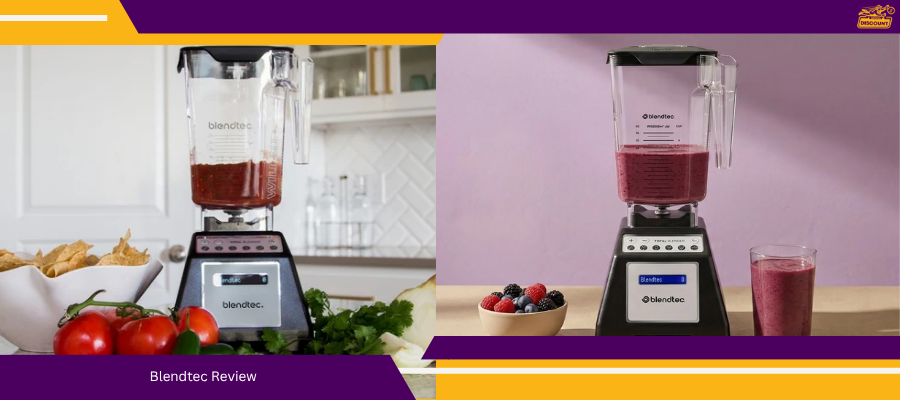
 Reviews
Blendtec Review 2026: Are Blendtec Blenders Worth It vs Vitamix?
September 09, 26
Quick Verdict
| Category | Verdict |
| Overall Rating | 9.0/10 |
| Best Overall | Designer 650 |
| Best Value | Total Blender Classic |
| Best for Smoothies | Classic 575 |
| Best Quiet Blender | Professional 800 |
| Best For | Smoothies, frozen drinks, soups, crushing ice and high-volume home blending |
| Biggest Strength | Serious blending power with exceptionally simple controls |
| Biggest Weakness | Standard models are loud, and Vitamix can be better for very thick recipes |
| Typical Price | About $400–$800 for the models reviewed |
| Verdict | Excellent high-speed blenders, provided you choose the right model |
Introduction: Is Blendtec Still Worth Buying in 2026?
Blendtec has one problem that most appliance companies would love to have: its reputation for raw power is so established that the more interesting question isn't whether its blenders can pulverize ingredients.
It's whether they're still worth $400, $500 or even $800 when the blender market is packed with alternatives. The company's infamous Will It Blend? campaign helped establish Blendtec as the blender capable of pulverizing absurdly tough objects. According to Blendtec's history, the campaign started in 2006 with a $50 budget and generated six million views within its first six days. But you aren't blending an iPhone for breakfast.
You need to know whether kale disappears into a smoothie, whether frozen fruit leaves chunks behind, whether soup comes out silky, whether cleanup is irritating and whether a Blendtec is actually better than spending similar money on a Vitamix. Those are the questions that matter in this Blendtec review. We researched Blendtec's current product specifications, warranty policies and pricing alongside independent performance testing. This review focuses on four models shoppers still regularly consider: the Classic 575, Total Blender Classic, Designer 650 and Professional 800. And there are meaningful differences between them.
Check Today's Price
What Is Blendtec?
Blendtec is a Utah-based blender manufacturer built around inventor Tom Dickson's work in high-powered kitchen equipment. Its history stretches back to Dickson's early grain-milling inventions before the company moved into commercial and residential high-speed blenders. Its influence on modern premium blenders is easy to underestimate. Blendtec credits its development history with innovations including preprogrammed blend cycles, capacitive-touch controls, five-sided blending jars and sound-dampening technology. Today, the company sells both residential and commercial equipment.
The residential machines covered here aren't intended for commercial use; Blendtec explicitly states that commercial use of those models can void their residential warranties. The basic Blendtec formula is remarkably consistent:
A powerful motor + unusually blunt blade + carefully shaped jar + automatic programs. Rather than relying entirely on razor-sharp blades, the system uses motor power and jar geometry to circulate ingredients through the blade. That simplicity is one of Blendtec's biggest attractions.
Blendtec Blender Reviews: Which Model Is Best?
Before getting into individual features, here's where the four major models fit.
| Blendtec | Best For | Motor | Standout Feature | Current MSRP* |
| Classic 575 | Smoothies | 1560W | Simple timed cycles | $399.95 |
| Total Blender Classic | Best value | 1560W | Six automatic programs | $399.95 |
| Designer 650 | Best overall | 1560W | Touchscreen + 8 speeds | From $449.95 |
| Professional 800 | Quiet kitchens | 1800W | Sound enclosure | $799.95 |
*Prices reflect Blendtec's U.S. website when researched in September 2026 and can change. The biggest surprise is that spending more doesn't necessarily buy dramatically smoother smoothies. What you're increasingly paying for is control, convenience, noise reduction, styling and warranty coverage.
Key Features
High-Powered Motors That Handle Difficult Ingredients
Both the Classic 575 and Total Blender Classic use 1,560-watt motors. The Professional 800 increases that to 1,800 watts. Those figures translate into genuinely useful performance. Independent testing by RTINGS found the Classic 575 particularly strong with fibrous ingredients and ice. It scored 9.6 for ice crushing and 9.7 for both multiple-serving smoothies and soups under that test methodology. That's more informative than simply quoting horsepower. A blender can have an enormous motor and still struggle if its jar doesn't circulate ingredients effectively. Blendtec's combination works particularly well with liquid-heavy recipes, frozen drinks, soups and conventional smoothies.
WildSide+ Jar Design
Blendtec's jar is one of the company's defining features. Instead of the conventional symmetrical four-sided pitcher, the WildSide+ incorporates an additional side designed to improve ingredient circulation. Blendtec says the WildSide concept was originally created in response to commercial customer requirements and combines its five-sided shape with a four-inch blade. In practical terms, that helps explain why these machines can produce strong results without a traditional tamper for most everyday blends.
It also keeps the overall pitcher relatively manageable on a kitchen counter. There is, however, an important limitation. Very thick mixtures don't circulate as freely as smoothies. That's where Vitamix's narrow jar and tamper system can become advantageous.
Blunt Blade Design
Calling a blender blade "blunt" sounds like criticism. With Blendtec, it's intentional. The idea is to use the motor's force to pulverize ingredients rather than depending on thin razor edges. One practical advantage is cleaning. You're not reaching around several knife-like blades every time strawberry fibers get trapped underneath. The fixed blade and simple jar also mean there aren't numerous components to disassemble after breakfast. For anyone who makes smoothies every morning, that matters more than another obscure automatic program.
One-Touch Blend Cycles
Automatic programs are another area where Blendtec differentiates itself. The Classic 575 provides Smoothie and Clean programs alongside 60- and 90-second timed cycles, five incremental manual speeds and Pulse. The Total Blender Classic expands that idea with six dedicated programs: Smoothie, Batters, Hot Soup, Whole Juice, Ice Cream and Ice Crush, plus ten speeds and Pulse. Designer 650 adds a more modern interface.
It uses a sealed capacitive touchscreen, eight manual speeds plus Pulse, preset cycles and a +10-second control. These programs aren't gimmicks if you actually multitask. Press Smoothie, walk away to rinse your knife, and the blender automatically varies its speed and stops. That's considerably nicer than hovering over a switch.
Blendtec Classic 575 Review: Best for Smoothies
The Classic 575 is arguably the easiest Blendtec to understand. It has a 1,560-watt motor, five incremental speeds, Pulse, an illuminated timer and automatic Smoothie, Clean, 60-second and 90-second programs. The current list price is $399.95. There's very little unnecessary complexity. For daily smoothies, that's an advantage.
Performance
Independent testing gives the Classic 575 a strong performance case. RTINGS found it capable of producing very smooth results with fibrous ingredients such as kale and blueberries, excellent crushed ice and smooth hot soups. It was also rated exceptionally easy to clean.
Where did it struggle?
Nut butter. RTINGS found that while it could process almonds, the resulting spread remained relatively crunchy. It also measured as a loud blender. That distinction matters. If 80% of what you make is smoothies, frozen drinks and soups, the Classic 575 is excellent. If you're buying a $400 blender specifically to make thick nut butters several times per week, we'd lean toward Vitamix.
Blendtec Total Blender Review: Best Value
The Total Blender Classic is an interesting product because it gives you more automatic programs than the 575 without moving into Designer pricing. It uses the same 1,560-watt motor but offers six dedicated cycles, ten speeds and Pulse. At the time of our research, Blendtec's individual product page showed it discounted from $399.95 to $349.95, although pricing varied elsewhere on the site. At $349.95, this is probably the sweet spot in the lineup.
You get automatic settings for smoothies, soup, ice cream, whole juice, batter and crushed ice without paying for the Designer 650's touchscreen styling. The trade-off is warranty length. Blendtec's current warranty table lists only two years of parts and labor coverage for the Total Blender and Classic 575. That's noticeably less compelling than the eight-year coverage on the Designer 650.
Blendtec Designer 650 Review: Best Overall
If we were choosing one Blendtec for the average premium-blender buyer, it would be the Designer 650. The current starting price is about $449.95, placing it roughly $50 above the Classic 575 at regular pricing. That extra money buys a noticeably more sophisticated interface. The Designer 650 combines a 1,560-watt motor with a fully sealed capacitive touchscreen, preset programs, eight manual speeds, Pulse and an LCD timer. The Gunmetal version is currently listed at $499.95 and carries an eight-year warranty.
Why We Prefer It
It's the warranty that changes the value equation. Blendtec currently lists the original Designer 650 with eight years of parts and labor coverage, compared with two years on the Classic 575 and Total Blender. For an appliance expected to live on your countertop for years, that difference is substantial. The touchscreen is also sealed and flat. Smoothie splashes don't collect around physical knobs, making the base particularly easy to wipe down. And eight manual speeds provide more control when you're trying to stop somewhere between chopped salsa and completely liquefied salsa.
Blendtec Professional 800 Review: Best Quiet Option
Then there's the Professional 800. It costs $799.95. That makes it difficult to recommend on value alone. But value isn't really the point. Noise is. High-speed blenders are notoriously loud, and Blendtec's standard models are no exception. The Professional 800 surrounds its jar with a dedicated sound enclosure using the company's Stealth sound-dampening technology. Underneath that enclosure is an 1,800-watt motor, six automatic cycles, an 11-speed touch slider, Pulse and an illuminated display. Blendtec backs the Professional 800 with a ten-year warranty. This is the Blendtec for someone making a smoothie at 6 a.m. while everyone else is asleep.
It's also attractive for open-plan kitchens, families with young children or anyone who simply hates the scream of a conventional high-speed blender. We would not call it silent. Even Blendtec-hosted customer feedback includes both enthusiastic praise for its reduced noise and at least one complaint that it remained louder than expected. The enclosure dramatically changes the experience, but an 1,800-watt blender is still moving ingredients at extraordinary speed.
First Impressions: Design, Setup & Everyday Usability
Blendtec's biggest advantage becomes apparent before you even make a smoothie. There isn't much to assemble. Place the base on the counter, position the jar and lid, add ingredients and select a speed or program. That's it. The Classic series looks functional rather than luxurious. The Designer 650 feels more appropriate in a modern premium kitchen thanks to its touchscreen interface, while the Professional 800 is inevitably bulkier because of the sound enclosure. The jars are refreshingly straightforward. There's no complicated removable blade stack, gasket assembly or collection of locking pieces.
That simplicity carries into cleaning. Blendtec recommends adding hot water and a small amount of dish soap, running the blender briefly and rinsing. The Professional 800's enclosure itself can be removed and wiped down. It's one of those features that sounds boring in a review but matters every single day. A blender that's annoying to clean eventually becomes a blender you stop using.
Performance & Real-World Experience
Smoothies
Smoothies are where Blendtec makes the strongest argument for itself. The Classic 575's independent test performance with fibrous ingredients suggests that kale, berries and similar ingredients aren't simply chopped—they can be processed into genuinely smooth drinks. For larger batches, the WildSide+ jar also gives ingredients enough room to circulate. Small portions can work well too, although none of these machines is as convenient as a dedicated personal blender if your priority is blending directly into a travel cup.
Frozen Fruit & Ice
Ice crushing is another standout. RTINGS scored the Classic 575 9.6 for ice crushing, describing its results as snow-like. That makes Blendtec especially compelling for frozen margaritas, frappés, slushies and thick frozen-fruit smoothies.
Soup
Blendtec can process hot ingredients on supported models, making it useful for pureed soups and sauces. The high blade speed can also add heat through friction when using dedicated hot-soup cycles. RTINGS rated the Classic 575 exceptionally highly for soup because it handled fibrous ingredients smoothly and supported hot blending.
Nut Butter & Very Thick Mixtures
Here's where the recommendation becomes more cautious. Blendtec's wide jar and tamper-free philosophy are convenient for ordinary recipes, but very thick mixtures can struggle to circulate. Independent testing of the Classic 575 produced a less-than-smooth almond butter. A Vitamix with a tamper gives you more direct control over ingredients that refuse to fall toward the blade. If homemade nut butter, hummus and extremely thick smoothie bowls dominate your recipe list, keep that in mind.
Noise
The Classic 575 is loud. That's not surprising for a 1,560-watt high-speed blender, but it is worth emphasizing because the machine can be unpleasant at full speed in a quiet kitchen. RTINGS also flagged noise as one of its notable disadvantages. The Professional 800 exists largely to solve this issue.
Blendtec Pricing & Value Analysis
Here's how the current range stacks up.
| Model | Current Price* | Warranty | Value Verdict |
| Classic 575 | $399.95 | 2 years | Good |
| Total Blender Classic | $399.95 MSRP | 2 years | Excellent on sale |
| Designer 650 | From $449.95 | 8 years | Best overall |
| Professional 800 | $799.95 | 10 years | Specialist purchase |
The Designer 650 stands out. Paying roughly $50 more than a regular-price Classic 575 for a more sophisticated interface and dramatically longer listed warranty makes sense. The Total Blender Classic becomes more attractive when discounted. Professional 800 is different. You're effectively paying hundreds of dollars to solve the noise problem. For a household that blends once every few days, that's hard to justify. For someone blending multiple times every morning, it could be worth every dollar. One caution applies to bargain hunting: Blendtec states that products bought from unauthorized sellers are not covered by its warranty. A suspiciously cheap marketplace listing isn't necessarily the better deal.
Explore BRAND Collections
Blendtec Pros & Cons
| Pros | Cons |
| Excellent smoothie performance | Standard models are loud |
| Superb ice crushing | Thick nut butter can be challenging |
| Powerful 1,560–1,800W motors | Premium pricing |
| Very easy cleanup | Classic warranty is only 2 years |
| Blunt fixed blade is easy to work around | No traditional tamper on core models |
| Useful automatic programs | Professional 800 costs nearly $800 |
| Hot blending on key models | Not every buyer needs this much power |
| Compact, distinctive jar design | Fewer accessories than some competitors |
| 8-year Designer 650 warranty | Marketplace bargains may lack warranty |
| 10-year Professional 800 warranty | Professional 800 enclosure adds bulk |
Who Should Buy a Blendtec?
Blendtec makes the most sense for someone who uses a blender frequently enough to appreciate the difference between an ordinary appliance and a high-speed machine. Daily smoothie drinkers are an obvious audience. So are families preparing large batches, people who regularly crush ice, soup makers and anyone who values automatic programs. The Designer 650 is particularly easy to justify for a household expecting to use the same blender for years because of its eight-year listed warranty.
| Buyer | Our Pick |
| Best overall | Designer 650 |
| Daily smoothies | Classic 575 |
| Best value | Total Blender Classic |
| Quietest setup | Professional 800 |
| Frozen drinks | Total Blender / Classic 575 |
| Modern kitchen | Designer 650 |
| Long warranty | Professional 800 |
| Budget under $400 | Total Blender when discounted |
Who Should Avoid Blendtec?
Don't spend $400 on a blender if you make one protein shake every Saturday. A simpler $100–$200 machine will probably meet that need. Blendtec also isn't our first recommendation for someone primarily interested in thick nut butters, extremely dense hummus or low-liquid smoothie bowls. Vitamix's tamper-driven approach can be more convenient for those recipes. Noise-sensitive shoppers should avoid the Classic 575 unless they're comfortable with normal high-speed-blender volume. And the Professional 800 makes little financial sense unless reduced noise is genuinely important to you.
Blendtec Customer Feedback Summary
Customer feedback is broadly consistent with what independent testing suggests: people buy Blendtec for power and simplicity, but noise and long-term hardware experiences can vary. The Classic 575's independently measured strengths include smoothie texture, ice crushing, soup performance and easy cleanup. Noise and nut-butter performance were its clearest shortcomings. Feedback displayed on Blendtec's Professional 800 product pages shows why individual expectations matter. One owner praised its quiet operation, easy cleaning and ability to fit beneath a 17-inch cabinet clearance with the enclosure attached. Another complained that their unit remained surprisingly loud and reported touchscreen trouble after ownership.
Those are individual customer experiences, not controlled tests, so they shouldn't be treated as universal outcomes. The more useful conclusion is that the Professional 800 reduces one of high-speed blending's biggest annoyances, but buyers shouldn't interpret “quiet” as literally silent. Warranty coverage also differs dramatically by model, making authorized-seller status particularly important.
Blendtec vs Vitamix: Which Is Better?
This is the comparison that matters most. Both companies make powerful premium blenders. But they take different approaches.
| Category | Blendtec | Vitamix |
| Smoothies | Excellent | Excellent |
| Ice crushing | Excellent | Excellent |
| Thick mixtures | Good | Excellent |
| Automatic cycles | Strong | Model dependent |
| Ease of cleaning | Excellent | Excellent |
| Tamper | Usually not needed/included | Core advantage |
| Touch controls | Excellent on Designer | Model dependent |
| Noise | Professional 800 wins | Loud on many models |
| Compact jar design | Strong | Varies |
| Manual control | Excellent | Excellent |
| Best for set-and-forget use | Blendtec | Very good |
| Best for hands-on thick blends | Good | Vitamix |
In Serious Eats' direct testing of a Blendtec Designer model against the Vitamix 5200, Vitamix ultimately won for overall versatility. Its narrow jar and tamper were particularly advantageous for emulsions and thick mixtures, while Blendtec stood out for ice crushing, compact design and automatic controls. That's a sensible way to frame the choice.
Choose Blendtec if:
You value automatic cycles, simple cleanup, excellent frozen-drink performance and a compact touchscreen design.
Choose Vitamix if:
You want maximum hands-on control, regularly make thick recipes and don't mind using a tamper. The gap isn't enormous. Both are premium machines capable of dramatically outperforming cheap countertop blenders.
Frequently Asked Questions
Is Blendtec worth it?
Yes, for frequent blender users. Blendtec's combination of strong smoothie performance, ice crushing, automatic programs and easy cleaning makes its premium easier to justify when the blender is used several times per week.
Is Blendtec a good blender brand?
Yes. Blendtec has a long history in residential and commercial high-speed blending and has developed technologies including preprogrammed cycles, five-sided jars and sound-dampening systems.
Which Blendtec blender is best?
The Designer 650 is our best overall choice because it combines a 1,560-watt motor, touchscreen controls, eight manual speeds, automatic cycles and an eight-year listed warranty.
Is the Blendtec Classic 575 worth it?
Yes, particularly for smoothies, soup and frozen drinks. Independent testing found excellent performance with fibrous ingredients and crushed ice, although it was loud and less impressive for nut butter.
What's the difference between Blendtec Classic 575 and Total Blender?
Both use 1,560-watt motors. The Classic 575 has five incremental speeds and simplified timed programs, while the Total Blender Classic provides ten speeds and six recipe-specific cycles.
Is the Blendtec Professional 800 really quiet?
It is specifically designed to dramatically reduce blending noise using a sealed sound enclosure and Blendtec's Stealth technology. However, it still contains an 1,800-watt high-speed motor, so “quiet” shouldn't be interpreted as completely silent.
How much does a Blendtec blender cost?
The models reviewed here currently range from about $399.95 for the Classic 575 and Total Blender Classic to $799.95 for the Professional 800. Designer 650 pricing begins around $449.95.
Blendtec vs Vitamix: which is better?
Vitamix has an advantage for very thick mixtures because of its jar geometry and tamper, while Blendtec excels at automatic blending, ice crushing, simple controls and easy cleanup. Serious Eats preferred the Vitamix 5200 overall in its direct comparison.
Can Blendtec make hot soup?
Yes, supported Blendtec models can handle hot blending, and several include dedicated Hot Soup programs. The Total Blender Classic, Designer 650 and Professional 800 all offer soup-oriented functionality.
Is Blendtec easy to clean?
Yes. The fixed blade and straightforward jar make cleanup simple. Blendtec recommends blending warm water with a small amount of dish soap and then rinsing.
How long is the Blendtec warranty?
It depends heavily on the model. Blendtec currently lists two years for the Classic 575 and Total Blender, eight years for the Designer 650 and ten years for the Professional 800.
Where are Blendtec blenders made?
Blendtec describes itself as Utah-based and says it supports more than 400 local families through its operations.
Final Verdict: Is Blendtec Worth It in 2026?
After comparing the current lineup, specifications, warranties and independent performance results, Blendtec remains one of the premium blender brands worth considering in 2026. The biggest reason isn't raw wattage. Plenty of cheaper blenders advertise enormous motors. Blendtec's advantage is how effectively the entire system works together: powerful motors, the WildSide+ jar, blunt blade, automatic cycles and refreshingly easy cleanup. The Designer 650 is our best overall choice. At roughly $450, it sits in the premium category but combines sophisticated controls with an eight-year warranty. The Total Blender Classic is the value pick, particularly when it falls below $400.
The Classic 575 remains an excellent smoothie machine backed by strong independent results for fibrous ingredients, ice and soups. And the Professional 800 solves a problem few other high-powered blenders seriously address: noise. Its $799.95 price makes it excessive for most kitchens, but for the right household, its sound enclosure can be the feature that matters most. Blendtec isn't unbeatable. Vitamix remains our preference for people who frequently prepare extremely thick mixtures and want the direct control of a tamper. Independent comparison testing also gives Vitamix an overall performance edge in certain demanding applications. But if your priorities are smooth smoothies, effortless frozen drinks, automatic programs and easy cleanup, Blendtec makes an exceptionally strong case.
Shop BRAND Now
You may also like