 Reviews
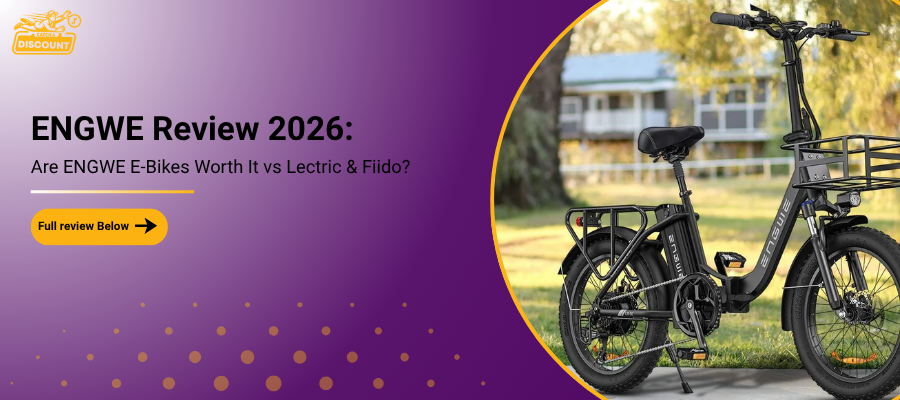
ENGWE Review 2026: Are ENGWE E-Bikes Worth It vs Lectric & Fiido?
September 10, 26
Quick Verdict
| ENGWE Review Verdict | |
| Overall Rating | 8.7/10 |
| Best Overall | Engine Pro 2.0 |
| Best For | Powerful folding bikes, fat-tire riding, recreational use |
| Major Pros | Strong motors, comfortable fat tires, competitive specs, distinctive designs |
| Major Cons | Heavy bikes, one-year core warranty, M20 ergonomics won't suit everyone |
| Value | Very Good |
| Our Take | Strong hardware for the money, but after-sales terms aren't as reassuring as the bikes themselves |
Introduction: Is ENGWE Worth It in 2026?
Shopping for an electric bike under $2,000 gets complicated surprisingly quickly. Specifications start sounding absurdly good: 750W motors, fat tires, suspension, hydraulic brakes, 28 mph assistance, enormous claimed ranges and frames that somehow fold. ENGWE sits right in the middle of that market. Its bikes aren't trying to be featherweight European commuters. Models such as the Engine Pro 2.0 and M20 are unapologetically chunky, powerful machines designed to deliver a lot of e-bike for the money. That makes the brand attractive but it also raises obvious questions.
Is ENGWE actually worth it? Are its range claims realistic? Is the Engine Pro 2.0 a genuinely useful folding electric bike, or simply an extremely heavy bike with a hinge? And should you buy ENGWE instead of a current Lectric eBikes XP4 or a Fiido?
For this ENGWE review, we examined current U.S. specifications and policies and cross-checked the brand's claims against independent reviews where available. One important point before we continue: we haven't personally ridden every ENGWE model discussed here. When describing ride characteristics, we distinguish ENGWE's specifications from observations made by independent testers rather than pretending those experiences are ours. The result is a much more useful answer than simply saying the bikes have impressive specs.
Check Today's Price
What Is ENGWE?
ENGWE specializes in affordable-to-midrange electric bikes with a particular emphasis on fat tires, folding frames, powerful hub motors and visually distinctive designs. Its target customer is different from someone shopping for an ultralight bicycle. ENGWE makes more sense for riders who want electric assistance to do a significant amount of work: recreational riders, commuters who value comfort over low weight, RV travelers, larger riders and people who encounter rough pavement, gravel or moderate trails. The Engine Pro line demonstrates that philosophy particularly well.
The Engine Pro 2.0 combines 20×4-inch tires, full suspension, a folding aluminum frame and a 750W rated motor. It isn't subtle, but subtlety isn't why you buy one. The M20 goes even further visually. It borrows heavily from café-racer and mini-motorcycle styling, using a fixed bench-style saddle, dual-crown fork, dual headlights and 20-inch fat tires. Independent reviewers have repeatedly described it as entertaining and eye-catching rather than a conventional bicycle.
ENGWE Engine Pro 2.0 Review
The Engine Pro 2.0 is the model we'd pick to represent what ENGWE does best. ENGWE lists it with a 750W rated hub motor producing 1,200W peak power and 75Nm of torque. It's paired with a 52V 16Ah lithium-ion battery, Shimano Altus 8-speed drivetrain, hydraulic disc brakes and 20×4-inch puncture-resistant tires. Those specifications are substantial for a folding bike.
ENGWE lists pedal-assist speed up to 28 mph, while throttle mode is specified at 20 mph. The company claims up to 68 miles in pedal-assist operation and around 30 miles using throttle mode. Those numbers should not be interpreted as guaranteed real-world range. E-bike range varies considerably with rider weight, terrain, temperature, tire pressure, wind, speed and assistance level. Using maximum assistance or relying heavily on the throttle will generally drain a battery much faster than low-level pedal assistance.
| Specification | Engine Pro 2.0 |
| Rated motor | 750W |
| Peak motor | 1,200W |
| Torque | 75Nm |
| Battery | 52V 16Ah |
| Tires | 20×4 inches |
| PAS speed | Up to 28 mph |
| Throttle speed | 20 mph |
| Claimed PAS range | Up to 68 miles |
| Claimed throttle range | 30 miles |
| Brakes | Hydraulic discs |
| Drivetrain | Shimano Altus 8-speed |
| Bike weight | 69.6 lb |
| Maximum load | 330 lb |
| Charging time | Approx. 6.5 hours |
Folding Design
Yes, the Engine Pro 2.0 folds.
No, that doesn't make it lightweight.
At 69.6 pounds, the Engine Pro 2.0 is closer to portable for a powerful fat-tire e-bike than genuinely portable in the conventional bicycle sense. Folded dimensions are approximately 104 × 55 × 84cm. That can make it practical for an RV, garage, large SUV or apartment where reducing its footprint matters. But if your plan involves regularly carrying the bike up three flights of stairs, rethink it. This is one of the most important distinctions in any best folding electric bike review: folding and easy to carry are not synonymous.
Motor, Torque and Acceleration
A 750W rated motor and 75Nm of torque put the Engine Pro 2.0 firmly in powerful recreational e-bike territory. That should be especially useful when accelerating a heavy bike, climbing moderate hills or moving a larger rider. Fat-tire e-bikes need that muscle. The same 4-inch tires that add comfort and traction also increase weight and rolling resistance compared with narrow commuter tires. The Engine Pro's motor therefore isn't merely there to produce an impressive specification sheet it compensates for the characteristics of the bike itself. The power level also means buyers need to check local e-bike regulations. A bike capable of 28 mph pedal assistance may fall into different legal classifications depending on where and how it is used.
52V Battery and Range
ENGWE uses a 52V 16Ah battery in the Engine Pro 2.0. That works out to roughly 832Wh of nominal energy capacity, giving the bike a sizeable battery for this price class. ENGWE advertises up to 68 miles under pedal assistance and 30 miles in throttle operation. That gap tells you something important. How you ride matters enormously. If maximum possible distance is important, lower assistance levels and active pedaling are the sensible approach. Treat 68 miles as an upper-end manufacturer figure rather than the distance every rider should expect.
Hydraulic Disc Brakes
Hydraulic brakes are exactly what we'd want on a nearly 70-pound e-bike capable of significant speed. ENGWE specifies hydraulic discs with 160mm rotors on the Engine Pro 2.0. Compared with basic mechanical disc brakes, hydraulic systems generally provide more progressive control and require less hand force. It's one of the reasons we prefer the Engine Pro 2.0 over the older M20 as an all-around recommendation. When a bike becomes faster and heavier, braking hardware becomes increasingly important.
Fat Tires and Suspension
The Engine Pro 2.0's 20×4-inch tires aren't just for appearance. A fat tire contains a large volume of air, which helps absorb small impacts while providing a broad contact patch on loose or inconsistent surfaces. Combine that with suspension and you get a bike geared much more toward comfort than a rigid commuter. The downside is familiar: fat tires add weight and rolling resistance. If your entire commute happens on pristine bicycle lanes, they're arguably unnecessary. If your route includes broken pavement, dirt, gravel and uneven recreational paths, their appeal is much easier to understand.
First Impressions, Assembly & Design
The first thing prospective buyers should understand is scale. Photos can make a folding 20-inch e-bike look compact. The Engine Pro 2.0 is still a substantial machine. ENGWE lists its shipping weight at 87.7 pounds. Inside the box are the bike, battery, charger, assembly tools, pedals and manual. Expect some setup rather than a bicycle that rolls out of the carton completely ready. As with any direct-to-consumer e-bike, we'd check brake alignment, tire pressure, fasteners and drivetrain operation before the first serious ride. Riders who aren't comfortable verifying bicycle setup should consider having a local bike shop perform a safety inspection.
Design-wise, the Engine Pro looks rugged rather than elegant. The folding hinge, thick frame tubes, large tires, battery and suspension all contribute to a purposeful appearance. The high-brightness LCD provides basic information including speed, battery status and mileage, while integrated front and rear lighting improves everyday usefulness.
ENGWE M20 Review
If the Engine Pro is a fat-tire bicycle with motorcycle attitude, the M20 pushes much further toward the motorcycle side. ENGWE currently lists the M20 at $1,699 but out of stock on its U.S. website, so availability is a major caveat in 2026. The listed configuration uses a 750W brushless motor, 55Nm of torque, 20×4-inch tires and either one or two 48V 13Ah batteries.
ENGWE advertises a maximum 28 mph speed, depending on conditions. The dual-battery configuration is where the M20 becomes particularly interesting: ENGWE's current specification claims up to 44 miles under throttle-only operation and as much as 150 miles under PAS level 1. Again, that 150-mile number is a best-case manufacturer claim, not a realistic expectation for every ride.
How Does the M20 Actually Ride?
Here we have useful independent evidence. BikeRadar rated the M20 3.5/5, praising its value, punchy power, entertaining ride and distinctive styling. The reviewer also highlighted wiring quality, range dropping quickly in high-power modes and the limitations of its one-size design. The same test found a comfortable position and stable handling, with the 4-inch tires providing plenty of grip. However, the reviewer noted that the motor could feel somewhat crude at maximum assistance and that it began struggling on steeper gradients above roughly 10 percent during their test.
TechRadar similarly liked its café-racer styling and dual-battery range but felt the mechanical disc brakes would have benefited from being hydraulic. Electrek reached a similar broad conclusion: the M20's individual components aren't especially premium, but the combination of power, range, suspension and low pricing makes the overall package work. That's a fair summary of ENGWE itself.
Real-World Performance: What ENGWE Gets Right
Comfort
Fat tires and suspension are a forgiving combination. On broken asphalt and recreational paths, an ENGWE should generally isolate the rider from imperfections more effectively than a rigid city bicycle with narrow high-pressure tires. The M20's independent testing supports this. BikeRadar found its steering composed and well balanced, with stable behavior through corners and plenty of grip from its large tires.
Range
Large batteries are one of ENGWE's selling points, particularly when compared with entry-level e-bikes using smaller battery packs. Just don't shop by the biggest range number alone. The M20 illustrates why: BikeRadar specifically observed that range can disappear quickly when using its more powerful modes. The same principle applies across the category.
Braking
Engine Pro 2.0 gets the advantage here thanks to its hydraulic setup. M20's cable-operated brakes received a more lukewarm assessment. BikeRadar found they could stop the bike but required substantial lever travel at speed, while TechRadar also wished ENGWE had fitted hydraulic brakes.
Portability
This is the Engine Pro's most obvious compromise. It folds impressively considering what it is, but 69.6 pounds is heavy. A folding mechanism makes storage and vehicle transport easier. It does not transform a fat-tire e-bike into something you'd want to carry through a train station every morning.
ENGWE Pricing & Value Analysis
ENGWE's value proposition is primarily equipment for the money. The Engine Pro 2.0's last listed U.S. price is $1,699, although ENGWE currently marks it unavailable and points shoppers toward its newer EP-2 3.0. M20 is also currently shown at $1,699 and out of stock. That current availability changes our recommendation. At a discount or while comparing remaining stock, Engine Pro 2.0 can still be compelling. At full $1,699 pricing, however, current competitors deserve serious attention.
For example, Lectric currently sells the XP4 750 for $1,299 with a 750W motor, 840Wh battery, torque sensor, hydraulic brakes, 330-pound payload rating and claimed maximum range of 85 miles. Fiido's current M1 Pro costs $1,209 and includes a torque sensor, hydraulic brakes, 556.8Wh removable battery, dual suspension and claimed 55.17-mile maximum range. That makes the 2026 market considerably tougher for an older $1,699 ENGWE.
Warranty & Returns Matter
ENGWE's U.S. warranty is another reason to evaluate price rather than specifications alone. The company currently lists 12 months for the frame, motor, battery and major electrical components, with shorter periods on several wear-related parts. Modified and secondhand e-bikes are excluded. ENGWE's current refund policy provides a 30-day return window, but bikes need to remain essentially unused under 10km on the display—and in their original condition and packaging. Non-quality returns can involve substantial shipping costs. Read those terms before ordering a 70-pound bicycle online.
Explore BRAND Collections
ENGWE Pros & Cons
| Pros | Cons |
| Strong motor specifications | Bikes can be extremely heavy |
| Large batteries on key models | One-year warranty on core components |
| Excellent comfort potential from fat tires | Manufacturer range claims require context |
| Engine Pro 2.0 has hydraulic brakes | M20 uses less impressive mechanical brakes |
| Folding Engine Pro is easier to store | Folding doesn't make it easy to carry |
| Competitive payload capacity | Direct-to-consumer service may require troubleshooting |
| Distinctive designs | M20's fixed seating limits fit |
| M20 dual-battery option offers huge capacity | Some current models are out of stock |
| Full suspension on featured models | Strong competition at $1,200–$1,700 |
| Good recreational versatility | Not ideal for cyclists wanting a lightweight ride |
Who Should Buy an ENGWE?
ENGWE makes the most sense for riders who prioritize power, comfort and features over low weight. The Engine Pro 2.0 is particularly attractive for someone who wants a fat-tire e-bike but needs to reduce its footprint for storage or transportation. It can also suit heavier riders: ENGWE lists a 330-pound maximum payload for the Engine Pro 2.0. M20 is different. Buy it because you want the styling and relaxed experience. Its motorcycle-inspired shape is part of the appeal, not an incidental design decision.
| Rider | Recommendation |
| Folding + fat tires | Engine Pro 2.0 |
| Best ENGWE overall | Engine Pro 2.0 |
| Motorcycle styling | M20 |
| Long-range recreational riding | Engine Pro 2.0 / dual-battery M20 |
| Rough pavement | Engine Pro 2.0 |
| Larger rider | Engine Pro 2.0 |
| Easy carrying upstairs | Neither |
| Traditional cycling feel | Consider Lectric/Fiido alternatives |
Who Should Avoid ENGWE?
Avoid these models if low weight is one of your top priorities. A 69.6-pound folding bike still requires serious effort to lift into a vehicle or carry upstairs. We'd also look elsewhere if you want a traditional lightweight cycling experience. Fat tires, powerful hub motors and substantial batteries inevitably change how a bicycle feels. The M20 is especially inappropriate for buyers who want highly adjustable ergonomics. Its motorcycle-style bench seat and one-size layout don't provide the same fit flexibility as a conventional bicycle saddle and adjustable seatpost. Finally, buyers who prioritize an extensive dealer network or long comprehensive warranty should compare support arrangements carefully. ENGWE's one-year coverage on its key components is acceptable but not exceptional.
Customer Feedback & Independent Review Summary
The most useful feedback on ENGWE isn't simply “fast and fun.” There's a pattern. Independent M20 reviewers consistently liked the amount of bike ENGWE provides for the money. BikeRadar praised its power, entertaining handling, value and styling, but flagged wiring quality, rapidly declining range at high assistance and one-size ergonomics. TechRadar liked the M20's appearance and range potential, particularly with dual batteries, but considered the braking hardware a weak point.
Electrek likewise found the component quality fairly basic but concluded that ENGWE compensates with a substantial feature package including power, range and suspension. That's more meaningful than treating every customer star rating as equivalent. The recurring theme is value over refinement. ENGWE gives you lots of motor, battery, tire and suspension. A more expensive premium bicycle may give you less dramatic specifications but better weight distribution, component integration, local support and overall polish. Know which side of that equation matters to you.
ENGWE vs Lectric vs Fiido
This is where the buying decision gets interesting. Current competition has improved dramatically.
| Feature | ENGWE Engine Pro 2.0 | Lectric XP4 750 | Fiido M1 Pro |
| Price* | $1,699 listed | $1,299 | $1,209 |
| Rated Motor | 750W | 750W | 250W |
| Peak Power | 1,200W | 1,310W | — |
| Torque | 75Nm | — | 50Nm |
| Battery | 52V 16Ah | 48V 17.5Ah / 840Wh | 556.8Wh |
| Claimed Max Range | 68 mi PAS | 85 mi | 55.17 mi |
| Tires | 20×4" | Multi-terrain | 20×4" |
| Hydraulic Brakes | Yes | Yes | Yes |
| Torque Sensor | — | Yes | Yes |
| Folding | Yes | Yes | Yes |
| Payload | 330 lb | 330 lb | 264.55 lb |
| Weight | 69.6 lb | ~71 lb incl. battery** | 59.08 lb |
| Best For | Rugged power | Everyday utility | Lighter fat-tire versatility |
Prices checked September 10, 2026 and can change. **Lectric lists 62 lb with the battery removed and a 9 lb battery.
ENGWE vs Lectric
This matchup is much closer than it once was. The current Lectric XP4 750 costs $1,299 and provides hydraulic brakes, a torque sensor, 750W motor, 840Wh battery, folding frame and up to 85 miles of claimed range. It is also UL 2849 certified, while its battery is UL 2271 certified. At current pricing, we'd pick Lectric XP4 750 for most U.S. commuters and utility riders. ENGWE Engine Pro 2.0 becomes more compelling if you specifically want its suspension-heavy, fat-tire setup or find it substantially discounted.
ENGWE vs Fiido
Fiido takes a somewhat different approach. The current M1 Pro costs $1,209, weighs 59.08 pounds with its battery and uses a 250W/50Nm motor with a torque sensor, hydraulic brakes, dual suspension and 20×4-inch tires. Fiido advertises up to 55.17 miles of range from its 556.8Wh battery. The ENGWE is the power-focused choice. The Fiido is lighter and more bicycle-like, with torque-sensing assistance that can provide a more natural response to pedaling. If maximum motor output is your priority, ENGWE. If weight, pedal feel and price matter more, Fiido deserves serious consideration.
ENGWE Review FAQ
Is ENGWE a good e-bike brand?
ENGWE offers strong specifications and competitive pricing, particularly for fat-tire and folding e-bikes. Independent M20 reviews praise its power, comfort and value while identifying compromises in refinement, braking hardware and ergonomics.
Is ENGWE worth it?
Yes, for the right rider and at the right price. ENGWE is particularly appealing if you want powerful assistance, fat tires, suspension and a folding design. Current competitors are very aggressive, however, so comparing the final price is essential.
Is the ENGWE Engine Pro 2.0 good?
The Engine Pro 2.0 has a compelling specification: 750W rated/1,200W peak motor, 75Nm torque, 52V 16Ah battery, hydraulic brakes, 8-speed Shimano drivetrain and full-size fat tires. Its main drawback is its 69.6-pound weight.
How fast is the ENGWE Engine Pro 2.0?
ENGWE lists a maximum of 20 mph in throttle mode and up to 28 mph with pedal assistance. Actual speed varies with conditions, and riders should comply with local e-bike laws.
How far can an ENGWE Engine Pro 2.0 go?
ENGWE advertises approximately 30 miles in throttle operation and up to 68 miles with pedal assistance. Real-world range can be substantially different depending on assistance level, rider weight, terrain and weather.
Is the ENGWE M20 worth buying?
The M20 can be worthwhile for riders who specifically want its café-racer styling, full suspension and dual-battery potential. Independent testing found it powerful, fun and comfortable but less refined in areas such as wiring and braking.
ENGWE vs Lectric: which is better?
For most U.S. buyers at current prices, the Lectric XP4 750 has the stronger value proposition at $1,299, including hydraulic brakes, a torque sensor, 840Wh battery and UL certification. ENGWE remains attractive for riders who specifically prefer its rugged suspension and design.
ENGWE vs Fiido: which should I buy?
Choose ENGWE if motor power and rugged fat-tire performance are priorities. Choose Fiido M1 Pro if you prefer lower weight, a torque sensor and a more natural pedal-assist experience.
Are ENGWE bikes good for off-road riding?
Models such as the Engine Pro 2.0 use fat tires and suspension that can work well on gravel and recreational trails. However, they shouldn't automatically be treated as substitutes for purpose-built high-end electric mountain bikes.
Are ENGWE electric bikes heavy?
Many are. The Engine Pro 2.0 weighs 69.6 pounds. This makes the folding mechanism useful for storage but doesn't make the bike particularly easy to carry.
What warranty does ENGWE offer?
ENGWE's current U.S. warranty lists 12 months for the frame, motor, battery and major electrical components, with shorter periods for several other parts. Exclusions apply to modifications, misuse and normal wear.
Does ENGWE offer returns?
ENGWE's current U.S. policy states a 30-day return period, with eligibility conditions including less than 10km on the display, original packaging and essentially unused condition. Non-quality returns can incur substantial shipping costs.
Final Verdict: Are ENGWE E-Bikes Worth It in 2026?
ENGWE's appeal is easy to understand. You get big batteries, powerful hub motors, chunky tires, suspension and distinctive designs without entering premium e-bike pricing. The Engine Pro 2.0 is our favorite of the two models reviewed. Its 750W rated motor, 75Nm torque, 52V battery and hydraulic brakes make it a serious recreational machine, while the folding frame adds genuine storage flexibility. Just don't confuse folding with lightweight. At nearly 70 pounds, this is a bike you fold to put in an SUV or reduce its garage footprint not something we'd want to carry through a subway station every day. The M20 is more specialized.
It's fun, visually distinctive and potentially capable of excellent range with two batteries. Independent testing supports its strengths in comfort, power and entertainment value, while also exposing compromises in refinement and braking. The bigger challenge for ENGWE in 2026 is competition. Lectric's XP4 750 now offers a torque sensor, hydraulic brakes, 840Wh battery and impressive specifications for $1,299, while Fiido's M1 Pro combines hydraulic brakes, a torque sensor and a significantly lighter 59-pound package for $1,209. That means ENGWE is no longer an automatic value winner.
Buy ENGWE when you specifically want ENGWE's combination of rugged styling, suspension, fat tires and high motor output or when a promotion makes the numbers particularly attractive. For those buyers, there's plenty to like. For riders primarily interested in light weight, refined pedal feel or traditional bicycle handling, we'd look elsewhere.
Shop BRAND Now
You may also like